In short
The TrueDepth camera has equipped certain iPhone and iPad models since 2017, initially for Face ID. It projects a grid of infrared dots to reconstruct a depth map, offering better resolution than LiDAR but a shorter range (roughly 15 cm to 1 m). Reliable for close-range scanning, it remains limited to Apple devices with Face ID, requires a mirror accessory for professional use, and doesn’t offer cross-platform compatibility. For professional 3D scanning aimed at O&P or medical compression, mobile photogrammetry offers a more ergonomic, cross-platform solution that doesn’t rely on a specific sensor or additional accessories.
What is the TrueDepth camera?
The TrueDepth camera is a sensor system developed by Apple, built into the front of certain iPhone and iPad models since 2017. It was originally designed for facial recognition with Face ID.
The system combines an infrared camera, a dot projector, and a proximity sensor. It captures the depth of a scene with a level of detail beyond that of a standard camera.
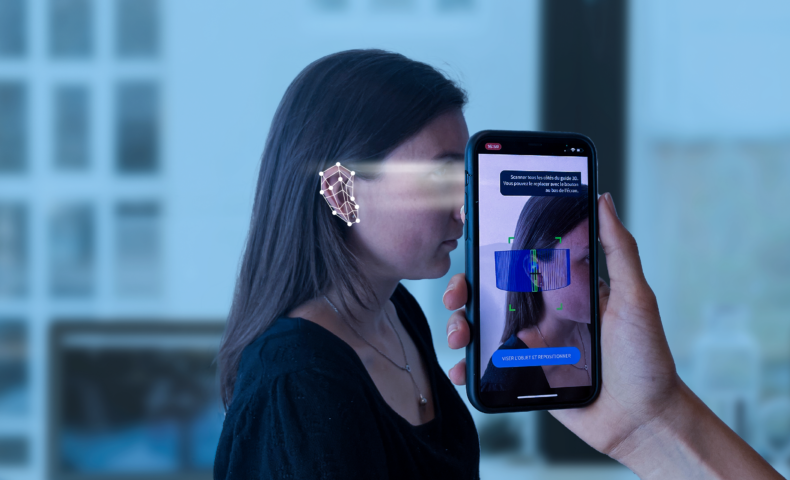
Thanks to this technology, the TrueDepth camera isn’t limited to facial recognition: it can also produce a 3D model of a face or a body area at close range.
How does TrueDepth scanning work?
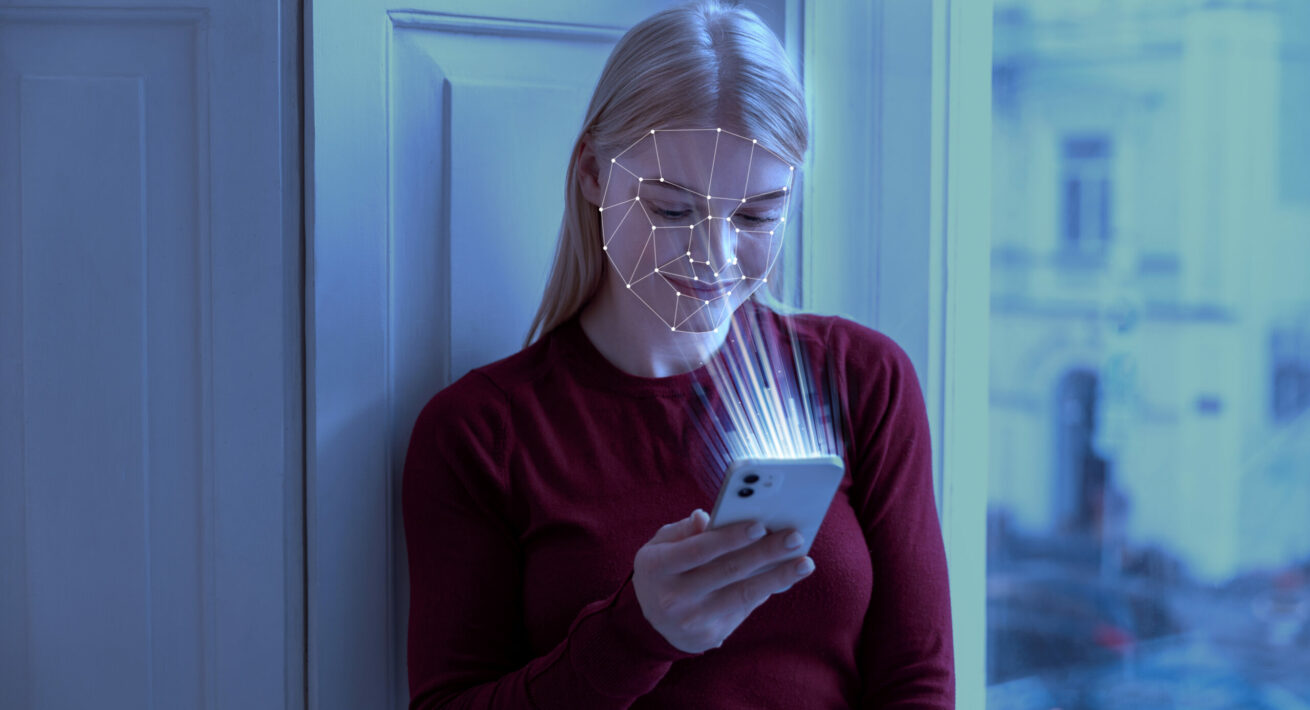
TrueDepth scanning relies on a structured light technique: a projector emits a grid of around 30,000 infrared dots onto the scanned area, and a dedicated infrared camera reads the distortion of that grid to calculate the distance of each point.
The 3 steps of a TrueDepth scan
Step 1: infrared dot projection
The projector casts a grid of invisible infrared dots onto the area to be scanned (face, hand, foot…).
Step 2: reading the depth map
The infrared camera captures the distortion of the projected pattern and calculates the distance of each point, generating a detailed depth map.
Step 3: 3D model generation
The data is assembled to produce a 3D model, including the volumes, textures, and colors of the scanned area.
What is the TrueDepth camera used for?
The TrueDepth camera has played a major role in making 3D capture from a smartphone mainstream. It’s used today for:
- facial recognition (Face ID);
- animated avatars (Animoji, Memoji);
- augmented reality applications;
- one-off morphological capture (face, hand, foot) for certain health and custom-fit use cases.
Is the TrueDepth camera suited to professional use?
Several constraints limit the large-scale professional use of the TrueDepth camera:
- Limited compatibility: only iPhone and iPad models with Face ID (starting with the iPhone X) have this sensor.
- Front-facing sensor: unlike LiDAR or photogrammetry, which use the rear camera, TrueDepth requires positioning the screen facing the area to be scanned, which makes it hard to scan certain areas since you can no longer see and follow what’s happening on screen.
- Use of an additional accessory: to work around the front-facing sensor constraint, a mirror can be clipped onto a dedicated mount on the iPhone, allowing the phone to be held horizontally so the screen stays visible during capture. However, on top of requiring an additional accessory, the mirror is fragile, needs to be kept clean, and can introduce instability during the scan (tracking loss).
In practice, the TrueDepth camera remains relevant for professional use, but comes with the constraints of needing an additional accessory and depending on a sensor that isn’t present on every phone on the market.
LiDAR, TrueDepth, Structure Sensor, mobile photogrammetry: how do they compare?
No discussion of professional 3D scanning is complete without mentioning the Structure Sensor, a long-standing reference in the industry. Like TrueDepth, it relies on infrared-assisted stereoscopy, but it’s a distinct sensor: an independent hardware accessory, developed by Structure, that attaches to an iPad.
| Criteria | LiDAR (iPhone/iPad Pro) | TrueDepth (iPhone and iPad with Face ID) | Structure Sensor (iPad accessory) | MyFit mobile photogrammetry (iOS and Android) |
| Principle | Time of flight (ToF) | Infrared-assisted stereoscopy | Infrared-assisted stereoscopy | Image processing via algorithms |
| Sensor type | Built into the device (Pro models only) | Built into the device (front camera) | Dedicated accessory, independent of the smartphone | No dedicated sensor: standard rear camera |
| Compatibility | iPhone Pro / iPad Pro | iPhone and iPad with Face ID | iPad | iOS and Android smartphones and tablets |
| Required accessory | None | Mirror, for professional use | Sensor attached via a bracket | None |
| Resolution | Low (~256×192 px) | Medium (~640×480 px) | High (up to 1040×1200 px) | Medium to high (configurable) |
| Applications | Large spaces, bulky objects | Human body, clinical use | Human body, clinical use | Human body, clinical use |
To go further, see our dedicated articles on LiDAR scanning and MyFit mobile photogrammetry.
Is the TrueDepth camera suitable for medical and O&P use?
For orthotists, prosthetists, podiatrists, and other custom medical device professionals, a 3D scan needs to meet specific requirements: mobility, no heavy equipment, simple deployment, field compatibility, and reliable data collection.
Given that it’s front-facing, the TrueDepth camera can work for various medical use cases, provided the mirror and its associated constraints are accepted, particularly for scanning larger areas like a torso or a full leg. This extra accessory is fragile, needs to be kept clean, and makes the scanning process less stable: the scan can drop more easily, particularly during broad or overly fast movements around the subject. Its compatibility being limited to recent Apple devices is also a constraint for multi-user or multi-site deployments, where a mixed fleet of devices (iOS and Android) is common.
What’s the alternative to the TrueDepth camera for a complete professional 3D scanning solution?
Given these limitations, MyFit Solutions relies on MyFit mobile photogrammetry for morphological 3D capture at a larger scale. Unlike older photogrammetry systems, this approach relies on an algorithm that stays resilient across variable lighting conditions and a proprietary scaling process, to produce a photorealistic, scale-accurate 3D model from simple photos taken with the smartphone’s rear camera — without depending on a specific depth sensor or any accessory.
The appeal for professionals working with custom medical devices: a solution that runs across a wide range of iOS and Android devices, with no accessory and no risk of tracking loss during the scan, delivering morphological data usable in clinical workflows (CAD, orthotic device design, patient tracking).
The full details of how this technology works are covered in our article on MyFit mobile photogrammetry.
FAQ
It offers good resolution, but the need for a mirror accessory for professional use, the constraints that come with it, and its compatibility being restricted to Apple devices make it less suited to medical use at scale.
TrueDepth uses a grid of infrared dots to capture at close range. LiDAR measures distance using time of flight (ToF) and works better for large spaces, with a one-meter minimum distance.
iPhone and iPad models compatible with Face ID, starting with the iPhone X (2017).
MyFit mobile photogrammetry generates accurate 3D models from smartphones, without a dedicated sensor or accessory, and is compatible with both iOS and Android.